
How to Calculate the True Cost of Your Handmade Products
If your handmade business feels like it is always just breaking even, the problem probably is not your products. It is the costs you do not know you are missing. Most makers count materials, estimate time, and stop there, leaving out failed batches, equipment wear, platform fees, and a dozen other real costs that quietly drain every sale.
This post builds your full cost stack from zero, layer by layer, so you can see exactly what each product actually costs before you set a price. Follow along with a real product from your own line and fill in your numbers as you go.
If you want to check your pricing after you build the stack, the free Batchforja pricing calculator can help you run those numbers quickly.
Key takeaways
Most handmade sellers underestimate their true cost because several real cost layers never make it into a standard pricing formula.
Failed batches and yield loss are a genuine production cost and need to be priced in, not written off.
Labor includes studio time like photography, listing creation, and packing, not just hands-on making.
Platform fees, equipment depreciation, and overhead can add up to more than your raw materials.
A healthy handmade business targets 40 to 60 percent gross margin after all costs and fees are included.
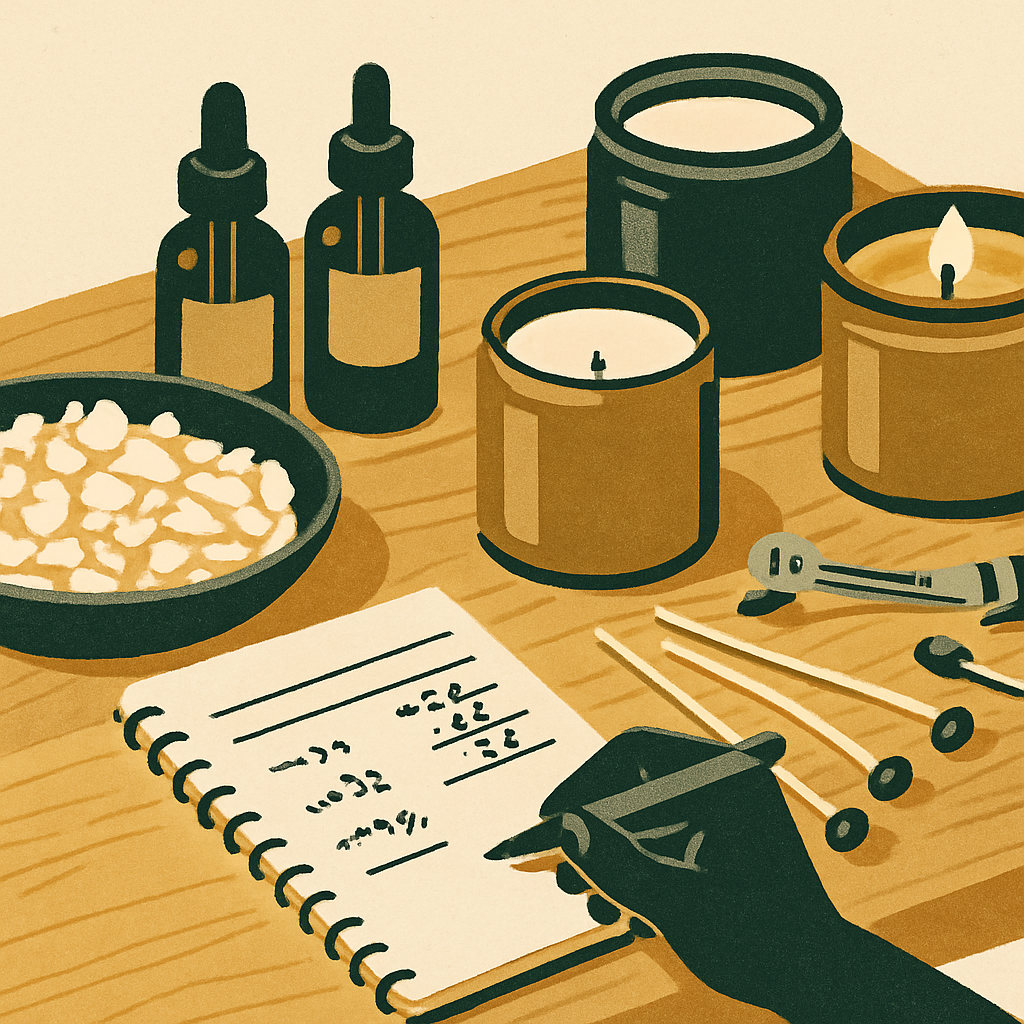
Why Most Handmade Pricing Falls Short
The standard formula circulating in most pricing guides looks like this:
List Price = (Materials + Labor + Overhead) × Markup
That formula is not wrong. The problem is how makers fill it in. Materials get counted carefully. Labor gets underestimated. Overhead gets hand-waved with a percentage guess. And several real costs never make it into the calculation at all.
Research into maker workflows consistently shows that most handmade sellers underestimate their actual production time by 30 to 50 percent, and that is before accounting for the hours spent photographing products, writing listings, answering messages, and packing orders. According to the U.S. Bureau of Labor Statistics, craft artists earn between roughly $10 and $32 per hour depending on experience. Many makers are effectively paying themselves below the floor of that range without realizing it.
The fix is not a better formula. It is a better process: a running cost ledger that you build line by line, starting at zero, so nothing gets skipped. If you would rather not build it by hand, you can use the free Batchforja calculator to do this automatically once you have your numbers ready.
How to Build Your Cost Stack
Pick one product. Work through each layer below and add the number to your running total. By the end, you will have an accurate floor cost for that product, the minimum it costs you to make and sell it.
Layer 1: Direct Materials
Start with every raw material that goes into one unit of the product. This means the actual quantity used, not the package size you bought.
To get the per-unit material cost for each ingredient:
Ingredient Cost Per Unit = (Package Price ÷ Package Size) × Amount Used Per Unit
Add up all your ingredient costs. That is your starting number.
Worked example (soy candle, 8 oz):
Material | Cost Per Unit |
|---|---|
Soy wax (9 oz used, $0.08/oz) | $0.72 |
Fragrance oil (0.8 oz used, $1.50/oz) | $1.20 |
Wick | $0.15 |
Glass jar | $1.40 |
Label | $0.18 |
Layer 1 total | $3.65 |
Running total: $3.65
Layer 2: Failed Batches and Yield Loss
This is the layer every competing guide ignores entirely. No maker has a 100 percent yield rate. Candles tunnel, soaps seize, glaze cracks, batches get contaminated. Those losses are a real cost of production, and they belong in your pricing.
To find your yield rate, track your last ten batches and calculate how many sellable units you actually produced versus how many you attempted. Then apply this adjustment:
Yield-Adjusted Material Cost = Layer 1 Total ÷ Your Yield Rate
If your yield rate is 90 percent (you lose roughly one unit in ten), divide your material cost by 0.90. A $3.65 material cost becomes $4.06. That extra $0.41 per unit is not waste. It is the real average cost of your successful units, with failure already priced in.
If you do not know your yield rate yet, a conservative starting estimate for most craft categories is 85 to 95 percent. Track your next five batches and refine it from there.
Running total after yield adjustment (90% yield): $4.06
Layer 3: Labor — All of It
Labor is almost always the most underestimated cost line. Most makers time the actual making and stop there. But making is only part of what your time produces.
For a complete labor cost, you need to account for:
Production time — the hands-on making, including setup and cleanup
Studio time — photography, listing creation, order packing, customer messages, bookkeeping
The simplest approach: time your next three full production sessions (start to finish, including setup and cleanup) and average the result. Then estimate how many additional minutes per unit you spend on studio tasks, listing updates, packaging, messages. Add both together.
Labor Cost Per Unit = (Total Minutes Per Unit ÷ 60) × Your Hourly Rate
On your hourly rate: be honest with yourself. Craft artists with meaningful skill and experience are worth more than minimum wage. The BLS data cited above puts the midpoint of the craft artist range around $20 per hour. If you have been charging $10 per hour or less, your pricing is subsidizing your customers at your own expense.
Example (candle maker, 12 min production + 3 min studio time = 15 min total, $20/hr):
Labor Per Unit = (15 ÷ 60) × $20 = $5.00
Running total: $4.06 + $5.00 = $9.06
Layer 4: Equipment Depreciation
Your tools and equipment are not free. They cost money to acquire, and they wear out over time. That wear belongs in your unit cost, not just on your tax return.
The calculation is straightforward:
Depreciation Per Use = Equipment Cost ÷ Estimated Lifetime Uses
A $600 candle-making pitcher and scale setup you expect to use 2,000 times over its life adds $0.30 per batch. A $400 heat gun used 1,500 times adds $0.27. None of these numbers are large individually, but they add up, and ignoring them means your prices are slowly subsidizing equipment replacement out of your personal funds.
List every major piece of equipment you use. Estimate how many units or batches it will produce before it needs replacing. Divide and add the result to your running total.
Example (all equipment combined): $0.55 per unit
Running total: $9.06 + $0.55 = $9.61
Layer 5: Overhead
Overhead is every business cost that does not go directly into a product but still exists because you run the business. A maker paying $50 per month in Etsy fees and subscriptions, $30 for software, $40 for shipping supplies, and $25 in card processing minimums is spending $1,740 per year on overhead that never appears in a recipe.
To calculate your overhead per unit:
Monthly Overhead Per Unit = Total Monthly Overhead Costs ÷ Units Produced Per Month
Common overhead items to include:
Platform subscription fees (Etsy Plus, Shopify plan, etc.)
Software and app subscriptions
Shipping supplies (tape, boxes, void fill, labels)
Packaging materials not included in the recipe
Card processing minimums
A proportional share of workspace costs if applicable
If you produce 80 units per month across all products and your monthly overhead is $145, that is $1.81 per unit. Add it to your running total.
Running total: $9.61 + $1.81 = $11.42
Layer 6: Sales Channel Fees
Every platform takes a cut. These fees are not overhead in the traditional sense. They vary by where the sale happens and they apply to the sale price, not the cost. But they affect your margin directly, so they need to be visible.
Etsy charges a $0.20 listing fee, a 6.5 percent transaction fee on the item price plus shipping, and a payment processing fee of approximately 3 percent plus $0.25. At a $24 sale price with $6 shipping:
Fee Type | Amount |
|---|---|
Listing fee | $0.20 |
Transaction fee (6.5% of $30 total) | $1.95 |
Payment processing (~3% + $0.25) | $1.15 |
Total Etsy fees | $3.30 |
To model these fees against any sale price, use the free Etsy fee calculator.
This leads directly to the free shipping trap.
Layer 7: The Free Shipping Trap
Free shipping is not free. When you absorb shipping into your item price, you pay postage out of pocket and Etsy's transaction fee applies to the combined item-plus-shipping total regardless. Let's look at the difference:
Shipping Charged Separately | Free Shipping (Rolled In) | |
|---|---|---|
Item price | $24.00 | $30.00 |
Shipping charged to buyer | $6.00 | $0.00 |
Etsy transaction fee (6.5%) | $1.95 (on $30) | $1.95 (on $30) |
Actual postage you pay | $6.00 | $6.00 |
Net revenue after postage and fee | $22.05 | $22.05 |
In this example, rolling in shipping does not change your margin, as long as you raise the item price by the full shipping amount. The problem is that most sellers do not. They roll in shipping at a discount to stay "competitive," effectively giving away margin. Treat shipping as a hard cost line, not a marketing lever.
Not sure if your floor cost is actually covering everything?
The cost stack method only works if every layer is accounted for. Run your materials, time, and overhead through the free Batchforja calculator to see your true cost per unit and a suggested price in minutes.
Try the free calculator →Your Complete Cost Stack
Here is the full picture for the candle example, built line by line:
Cost Layer | Per Unit | Running Total |
|---|---|---|
Direct materials | $3.65 | $3.65 |
Yield adjustment (90%) | +$0.41 | $4.06 |
Labor (15 min at $20/hr) | $5.00 | $9.06 |
Equipment depreciation | $0.55 | $9.61 |
Overhead | $1.81 | $11.42 |
Platform fees (Etsy) | $3.30 | $14.72 |
Postage absorbed | $6.00 | $20.72 |
True floor cost | $20.72 |
A seller pricing this candle at $24 with free shipping is making just over $3 per unit before profit. That does not leave room for growth, restocking, or a slow month. A seller pricing it at $28 to $32 with shipping charged separately is making closer to $7 to $11, a real margin. If you want to run these numbers for your own products, use the free Batchforja calculator to do this automatically rather than working through it all by hand.
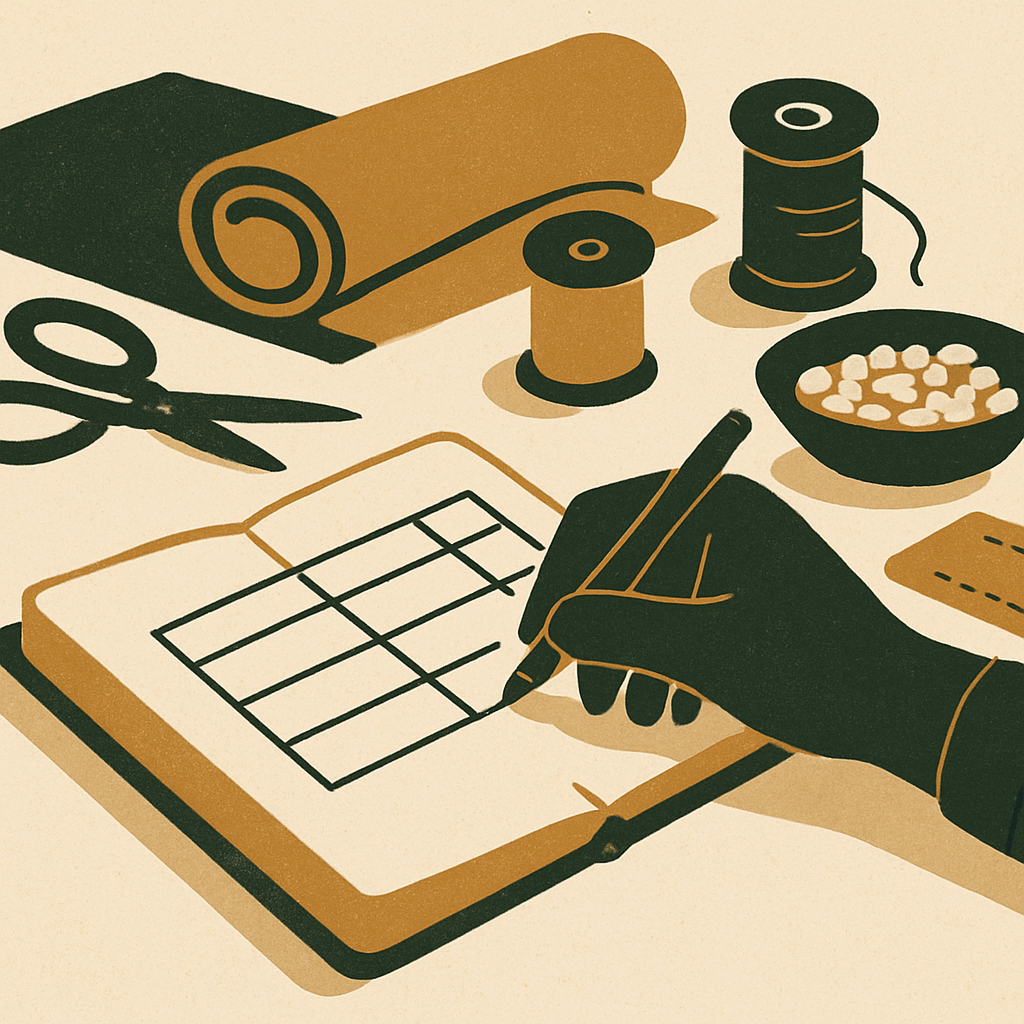
The Cost Stack Health Check
Once you have your floor cost, check your margin against this benchmark:
Gross Margin % = ((Selling Price - Floor Cost) ÷ Selling Price) × 100
A healthy handmade business generally targets 40 to 60 percent gross margin after materials, labor, overhead, and fees. Below 30 percent, the business has limited resilience against slow seasons, rising material costs, or unexpected expenses.
If your margin is below 30 percent, there are three levers to examine:
Price: Is the current price reflecting actual value, or is it set by fear of being too expensive?
Labor efficiency: Can you batch more effectively to reduce per-unit time without cutting quality?
Overhead: Are there subscription or supply costs that can be reduced or renegotiated?
Raising prices is almost always the most effective lever and the one makers are most reluctant to pull. Underpricing, not poor quality, is the primary reason well-made handmade businesses fail.
Keeping Your Cost Stack Current
Material prices change. Your production speed improves over time. Platform fees get updated. A cost stack you built a year ago may no longer reflect reality.
Review each product's cost stack at minimum once a year, and any time a significant input cost changes, a key supplier raises prices, you switch platforms, or postage rates increase. Small shifts in individual layers compound across a full product catalog.
If you are tracking materials and production in a dedicated system, this review becomes much faster. Batchforja links recipes directly to current material costs, so your cost calculations stay accurate as prices update. You can create a free account to see how it works for your product line.
For a broader look at how inventory tracking fits into a healthy handmade business, the Batchforja blog covers production planning, channel management, and pricing across a range of craft categories.
Are your product costs still based on what materials cost 12 months ago?
When your ingredient prices, platform fees, or shipping rates change, Batchforja updates your recipe costs automatically as you log new purchases, so your numbers stay accurate without a manual audit every quarter.
Learn more →Start With Your Next Product
The cost stack process is not complicated, but it does require honesty, about your time, your yield rate, and what the business actually costs to run. Most makers who go through it for the first time discover they have been leaving money on the table, not because their prices are too high, but because their math was incomplete.
Pick one product. Build the stack from Layer 1. Add each layer until you have a real floor cost. Then check the margin. That single exercise, done carefully, will tell you more about your business than any pricing formula.
The free Batchforja pricing calculator can help you run the final margin check once your cost stack is complete.