
How to Price Handmade Soap So You Actually Make Money
The Number Most Soap Makers Never Count
Pricing handmade soap means calculating every cost that goes into a bar: ingredient costs + labor + overhead + channel fees, divided by units per batch, equals your minimum viable price. After reading this post, you will be able to build a complete cost per bar for your own recipes, set a defensible price floor for every sales channel, and identify where your current pricing may be leaving money on the table.
Before we touch ingredients, consider this: a standard cold process batch of 12 bars takes roughly two hours from setup to cleanup. If you value your time at $25 per hour, that is $4.17 in labor cost per bar before a single drop of olive oil is measured.
Most soap makers never count that number. They add up their oils, lye, and fragrance, divide by bars yielded, and land somewhere around $2.50 per bar in material costs. They feel good about that. Then they price their soap at $8 and wonder why they can never get ahead.
This post walks through exactly how to price handmade soap so that every cost is accounted for: ingredients, labor, overhead, platform fees, and the hidden leaks that quietly drain margin on every batch. You will get a fully worked example with real numbers, a three-channel pricing table, and a minimum price floor you can apply to your own batches today.

Key Takeaways
Pricing handmade soap is a math problem, not a confidence problem. The confidence comes after you have run the numbers honestly.
Labor is almost always your largest cost per bar. Count it at a real hourly rate before you do anything else.
Your cost per bar needs to include ingredients, labor, overhead, packaging, and inbound shipping on supplies.
Every sales channel has different fees attached. Your Etsy price, craft fair price, and wholesale price should not be identical.
Wholesale only works if your cost per bar is roughly 25% or less of retail. Check that math before accepting wholesale orders.
Your minimum price floor is a calculation: total cost divided by your target margin, plus channel fees. Below that number, you are not running a business.
Hidden costs like waste, cure time, and fragrance variation are real. Estimate them and build them in.
Bulk ingredient purchasing is the most direct way to reduce cost per bar over time.
If your current prices do not hold up when you run the numbers in this post, that is useful information. Raise them. The market for well-made handmade soap supports honest pricing. The math just has to be honest first.
Still guessing at your cost per bar?
Labor, overhead, packaging, inbound shipping on supplies — the number of inputs that go into a real cost per bar surprises most soap makers. Run yours through the free Batchforja calculator and see exactly what each bar costs you before you set a single price.
Try the free calculator →Why Soap Pricing Goes Wrong
The most common mistake is not ignorance of the formula. Makers generally know they should be covering costs and adding a markup. The mistakes happen in the execution, specifically in three places.
Copying Etsy prices
Etsy is full of soap priced at $5 to $7 a bar. Some of those sellers are hobbyists who do not track their time and are effectively subsidizing their customers. Some are buying premade bases and working with much lower material costs. Matching their price means running your business on their cost structure, which has nothing to do with yours.
Forgetting labor entirely
Labor is often the largest single cost in a handmade soap operation. A 2 lb batch that yields 8 bars and takes 90 minutes of active work carries about $2.81 per bar in labor at a $15/hour rate, and $4.69 at $25/hour. Most pricing guides mention labor as a line item. Few make clear that it regularly outweighs ingredient costs.
Pricing the loaf, selling the bar
Cold process soap is made in loaves and cut into bars. If you calculate your batch cost but divide imprecisely by expected yield, small errors compound into large ones. A 2 lb batch yielding 9 bars instead of 10 changes your cost per bar by more than you might expect across a year of production.
Still pricing your soap by what everyone else charges on Etsy?
Copying competitor prices means inheriting their blind spots, including the time they never tracked and the overhead they forgot to count. Run your own numbers to find out what your soap actually costs to make and what you need to charge to come out ahead.
Try the free calculator →The Full Pricing Formula
Pricing handmade soap follows the same logic as pricing any manufactured good. You need to recover every cost and apply a margin that reflects your positioning in the market.
Cost Per Bar = (Material Costs + Labor + Overhead + Packaging) ÷ Bars Yielded
Retail Price = Cost Per Bar ÷ (1 - Target Margin %)
A 50% margin is a reasonable starting point for retail. That means if your cost per bar is $4.00, your retail floor is $8.00. That is not a recommended price. That is the minimum at which you break even on margin. Your actual price should reflect your market positioning, ingredient quality, and brand.
For wholesale, the traditional model prices at 50% of retail. At a $14 retail bar, that is $7 wholesale. Your cost per bar needs to be well under $3.50 for wholesale to make sense. More on that below.
A Fully Worked Example: Lavender Cold Process Batch
Rather than leave you with a formula to fill in yourself, here is a complete walkthrough using a simple 2 lb lavender cold process recipe. The ingredient prices below reflect 2025 mid-range retail costs for small-batch purchasing. Your actual costs will vary depending on your suppliers and purchase quantities.
Batch details
Batch size: 2 lbs of oils (approximately 908g)
Expected yield: 10 bars at approximately 3.5 oz each (accounting for water evaporation during cure)
Fragrance: lavender essential oil at 3% of oil weight
Cure time: 4 to 6 weeks
Ingredient costs
Ingredient | Amount Used | Cost Per Oz | Line Cost |
|---|---|---|---|
Olive oil | 14.4 oz | $0.34 | $4.90 |
Coconut oil | 6.4 oz | $0.28 | $1.79 |
Castor oil | 1.6 oz | $0.44 | $0.70 |
Sodium hydroxide (lye) | 3.9 oz | $0.21 | $0.82 |
Distilled water | 8.5 oz | $0.02 | $0.17 |
Lavender essential oil | 0.7 oz | $2.10 | $1.47 |
Colorant (purple mica) | 0.2 oz | $1.80 | $0.36 |
Total ingredient cost | $10.21 |
Ingredient Cost Per Bar = $10.21 ÷ 10 bars = $1.02 per bar
Labor costs
Task | Time |
|---|---|
Measuring and prep | 20 min |
Mixing and pouring | 25 min |
Cleanup | 15 min |
Unmolding and cutting | 15 min |
Labeling and packaging | 20 min |
Total labor time | 95 minutes |
Labor Cost Per Bar (at $20/hr) = (95 min ÷ 60) × $20 ÷ 10 bars = $3.17 per bar
That single number deserves a pause. $3.17 per bar in labor versus $1.02 per bar in ingredients. Labor is three times the ingredient cost. This is the gap that underpriced soap lives in.
What happens when you run 3 loaves in one session
The single-loaf example above is honest, but it is also the most expensive way to produce. Here is why: some of the labor time in that 95-minute total is fixed per session, not per loaf. Setup, cleanup, and workspace preparation take roughly the same amount of time whether you are making one loaf or three.
In the single-loaf breakdown, setup and cleanup account for approximately 35 minutes (the 20-minute prep and 15-minute cleanup). Mixing, pouring, unmolding, cutting, labeling, and packaging are variable. They scale with the number of loaves. When you run 3 loaves in a single session, the fixed 35 minutes is shared across 30 bars instead of 10, while the variable tasks scale proportionally.
Task | 1 Loaf (10 bars) | 3 Loaves (30 bars) | Notes |
|---|---|---|---|
Setup and prep | 20 min | 20 min | Fixed per session |
Mixing and pouring | 25 min | 60 min | Scales with loaves |
Cleanup | 15 min | 15 min | Fixed per session |
Unmolding and cutting | 15 min | 35 min | Scales with loaves |
Labeling and packaging | 20 min | 50 min | Scales with loaves |
Total session time | 95 min | 180 min |
Labor Cost Per Bar at $20/hr, 3-loaf session = (180 min ÷ 60) × $20 ÷ 30 bars = $2.00 per bar
That is a reduction of $1.17 per bar in labor cost from the single-loaf scenario — purely by batching your production. With the same ingredient cost ($1.02) and overhead per bar ($0.53), your revised total cost per bar drops to $3.55.
Revised retail floor at 50% margin = $3.55 ÷ 0.50 = $7.10, plus channel fees.
On Etsy, that puts your floor around $8.50 to $9.00. At a craft fair, you are comfortably profitable at $12 to $14, which happens to be exactly what buyers at well-run craft markets and boutique shops expect to pay for a quality handmade bar. The three-loaf production session is not a production hack. It is the practical path to a price point that feels natural to your customer and still works for your business.
Total cost per bar
Total Cost Per Bar = $1.02 (ingredients) + $3.17 (labor) + $0.53 (overhead and packaging) = $4.72
The channel pricing table below uses the single-loaf cost of $4.72 as a conservative baseline. If you are producing 3 loaves per session, substitute your $3.55 cost per bar into the same calculations for a more accurate picture.
A well-made cold process lavender bar costs roughly $4.72 to produce when you count everything. If you are selling it for $8, you are making $3.28 before platform fees, and your margin is just over 41%. That is a slim position to be in. If you are selling it for $12, the picture improves significantly.
Pricing for Each Sales Channel
The same bar does not carry the same price everywhere. Every channel has different costs attached to it, and your pricing needs to reflect those differences. Selling at a uniform price across Etsy, craft fairs, and wholesale is one of the fastest ways to make a channel unprofitable without realizing it.
Here is how the lavender bar above should be evaluated across three common channels. Starting with a target retail price of $13.
Channel | Retail Price | Channel Costs | Net Revenue | Profit Per Bar | Margin |
|---|---|---|---|---|---|
Craft fair | $13.00 | Booth cost allocated (~$0.50/bar) | $12.50 | $7.78 | 62% |
Etsy | $13.00 | ~$1.46 in fees (6.5% transaction + $0.20 listing) | $11.54 | $6.82 | 59% |
Wholesale | $6.50 (50% of $13) | None | $6.50 | $1.78 | 27% |
Wholesale is the most revealing number. At a $13 retail price with a $4.72 cost per bar, wholesale margin is thin. If your cost per bar were $4.00 or higher, wholesale would barely cover production costs. That is not unusual for small-batch makers, and it is one of the main reasons wholesale needs to be evaluated carefully before committing to it.
According to Etsy's published fee structure, the Etsy Seller Handbook breaks down transaction fees, listing fees, and payment processing charges. Running your numbers through those before setting your Etsy price is not optional. It is basic math.
What wholesale actually requires
Traditional wholesale pricing means a retailer buys at 50% of your retail price and marks up to retail. For that to work for you, your cost per bar generally needs to be 25% or less of retail. On a $13 bar, that means a cost per bar of $3.25 or under.
If your cost per bar is $4.72 as in our example, you have two options: raise your retail price to at least $19 before offering wholesale, or reduce your production costs through bulk ingredient purchasing and higher batch volumes. Both are legitimate paths. Pretending the math works when it does not is not.
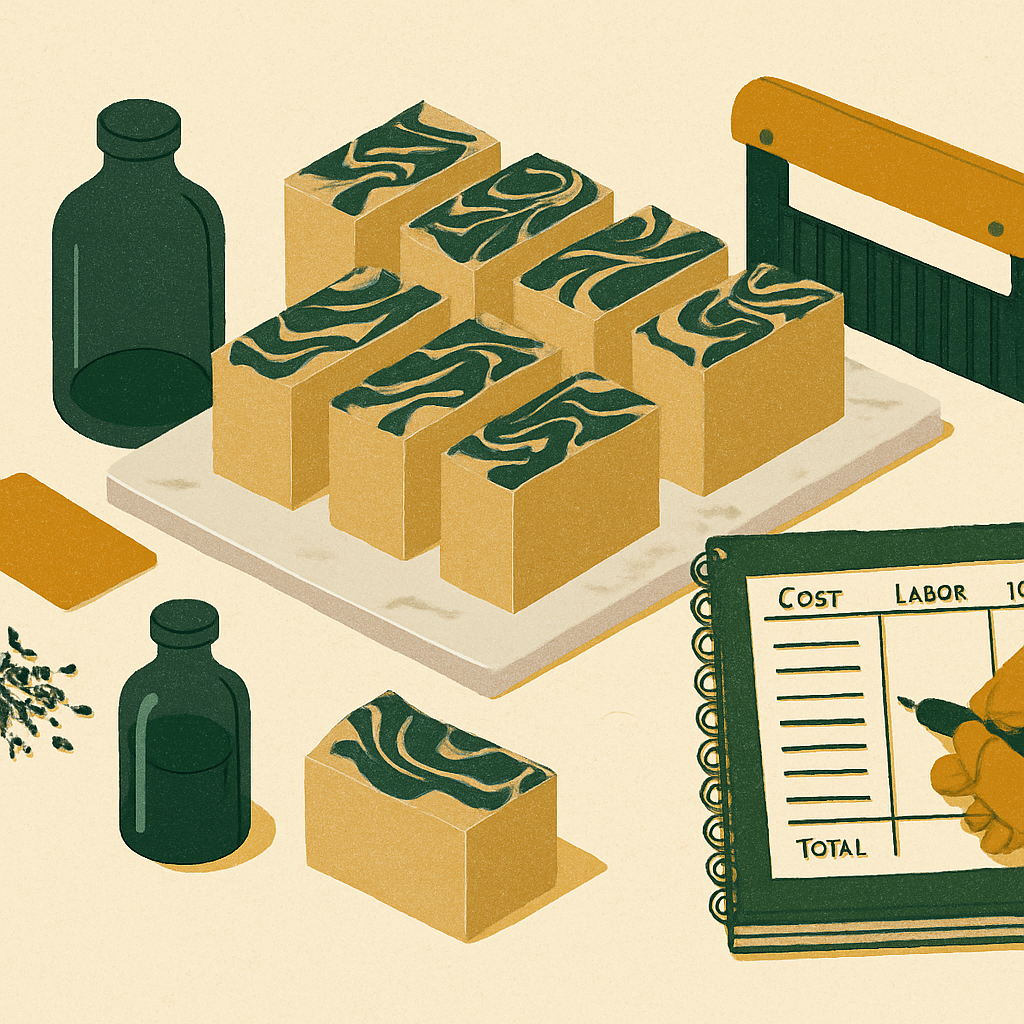
Hidden Costs That Eat Your Margin
Beyond the main line items, there are recurring costs that most soap makers either undercount or ignore entirely. None of them are large individually. Together they can represent $0.50 to $1.50 per bar in unrecovered cost.
Inbound shipping on supplies
Oils, lye, fragrance, and colorants all have to get to you. If you are ordering from suppliers like Bramble Berry or similar, shipping costs often add 15 to 25% to your supply cost. A $40 ingredient order with a $9 shipping fee raises your effective cost on every ingredient by about 22%. This needs to be in your cost calculation.
Soap ends and waste
Every loaf loses something to the cut. End pieces that are unsellable, bars that crack or ash or are otherwise unsaleable, testing bars used for product photos or gifts. A reasonable loss rate is 5 to 10% of each batch. If you are calculating yield at 100%, you are underpricing by that amount.
Fragrance cost variance
A basic lavender essential oil costs very differently from a rose absolute. If you have a standard bar price and some of your bars use premium fragrances, those bars are quietly running at lower margins. Track fragrance cost per recipe, not per collection.
Cure time as working capital
Cold process soap cures for 4 to 6 weeks before it can be sold. That means the money you spent on ingredients, the labor you performed, and the overhead you incurred is locked up in bars sitting on a shelf for over a month before any revenue returns. For a maker producing $500 worth of soap per batch, that is $500 of working capital tied up at any given time. It is not a direct cost per bar, but it is a real constraint on how fast you can grow, and it is one reason cash flow management matters from your first batch forward.
R&D and testing batches
New recipes require test batches. Those batches cost money and time, and they rarely yield sellable product. The cost of recipe development belongs in your business overhead, spread across all your products. Even a rough allocation, like adding $0.10 to $0.20 per bar for ongoing R&D, is more honest than ignoring it.
Photography and listing time
Product photography, writing listing descriptions, and managing your online presence take real time. If you spend two hours photographing a new batch, that time has a cost. It may not go directly into your per-bar cost calculation, but it is part of your total business labor, and it reinforces why your hourly rate matters.
The Effect of Buying in Bulk
One of the most direct levers you have on cost per bar is purchasing volume. Olive oil bought in a 1 lb bottle from a grocery store and olive oil bought by the gallon from a soap supply house are not the same cost per ounce, sometimes by 30% or more.
The math here works in both directions. Buying in bulk reduces unit cost, which improves margin per bar. But bulk buying requires upfront capital, and more stored inventory means more working capital tied up in materials. The right purchase quantity depends on your cash position and how quickly you turn inventory.
Purchase Quantity | Approximate Cost Per Oz (Olive Oil) | Cost in a 2 lb Batch | Savings vs. Small Purchase |
|---|---|---|---|
1 lb (retail) | $0.40 | $5.76 | Baseline |
1 gallon (bulk, soap supplier) | $0.28 | $4.03 | $1.73 per batch |
5 gallon (wholesale quantity) | $0.20 | $2.88 | $2.88 per batch |
On a 10-bar batch, moving from retail to gallon-size olive oil purchasing saves about $0.17 per bar on that ingredient alone. That may not sound like much, but across a year of production it adds up, and it applies to every oil in your recipe. Ingredient cost is the one cost in your structure you can actively reduce through purchasing decisions.
The Small Business Administration's guide to managing your finances covers budgeting, cash flow, and recordkeeping practices that apply directly to this kind of purchasing decision. It is worth a read if you are scaling up.
Setting Your Minimum Price Floor
Every soap maker needs a number below which they will not sell, regardless of what competitors are doing. This is your minimum viable price, and it is a factual calculation, not a feeling.
Minimum Retail Price = (Total Cost Per Bar ÷ 0.50) + Channel Fees
The 50% in that formula represents your target margin. You are working backward: if cost per bar is $4.72 and you want a 50% margin, your floor is $9.44, before channel fees. On Etsy, add roughly $1.00 to $1.50 to that number to account for transaction and listing fees. Your Etsy floor on this bar is approximately $10.50 to $11.00.
Below that number, every bar you sell is either generating less margin than your business needs or, if priced below cost, actively losing money.
What the market is actually paying
Search Etsy for cold process soap and you will find individual bars clustered in the $6 to $8 range, and that is exactly the problem this post exists to solve. Those prices reflect makers who have not counted their labor, not a healthy market rate. If you look at those listings and conclude that $12 to $14 is unachievable, your skepticism is understandable. But it is based on observing a broken pricing environment, not a well-functioning one.
Etsy's search results for handmade soap are dominated by hobbyists and melt-and-pour sellers who are not tracking their time and are not running sustainable businesses. Their prices are a symptom of the math problem this post is trying to solve. They are not a benchmark you should be pricing against.
The more useful comparison is craft fairs and boutique retail, where buyers are not side-by-side comparison shopping against hobbyists. In those environments, $12 to $15 for a well-made cold process bar is common and accepted. Customers who buy handmade soap at a market or in an independent shop are paying for quality, craft, and the choice to support a real maker. They know what a $6 bar looks like, and they chose not to buy it. Your pricing should reflect that reality, not the race to the bottom happening in Etsy search results.
Raising your price is not the last resort
Many makers treat a price increase as something to do when they are desperate. It is more useful to think of your current price as a hypothesis. You set it based on what you knew at the time. Now you have better information. Adjust accordingly.
The Handmade Seller Magazine and similar communities regularly publish data on how handmade buyers perceive price as a quality signal. In most craft categories, underpricing does not attract more customers. It attracts skepticism.
What is your actual cost per bar right now, down to the cent?
Your minimum price floor is only as solid as the cost number underneath it. Batchforja tracks your materials, batch yields, and overhead so you always know exactly what each bar costs before you set a single price.
Learn more →Psychological Pricing and Confidence
Once you have a floor, the question becomes where to land above it. There are a few principles worth knowing.
Charm pricing has limits in the handmade market
Pricing at $9.99 instead of $10 is a retail convention developed for mass-market goods. Handmade buyers often respond differently. A bar priced at $14 can feel more premium and intentional than one at $13.99. The pricing convention should match your brand positioning. For most independent soap makers, round numbers communicate confidence. Fractional prices can read as discount-seeking.
Price anchoring through product tiers
If you offer multiple soap products, the highest-priced item in your lineup makes your mid-tier bars feel accessible by comparison. A $22 specialty bar with a premium essential oil blend makes a $14 lavender bar feel like a reasonable everyday choice. Deliberate product range construction is a form of pricing strategy.
Do not apologize for your price
Listing descriptions that lead with cost justification signal uncertainty. Customers who buy handmade soap are not looking for the cheapest option. They are buying quality, craft, and the choice to support an independent maker. Your listing copy should lead with those things, not with an explanation of why you charge what you charge.